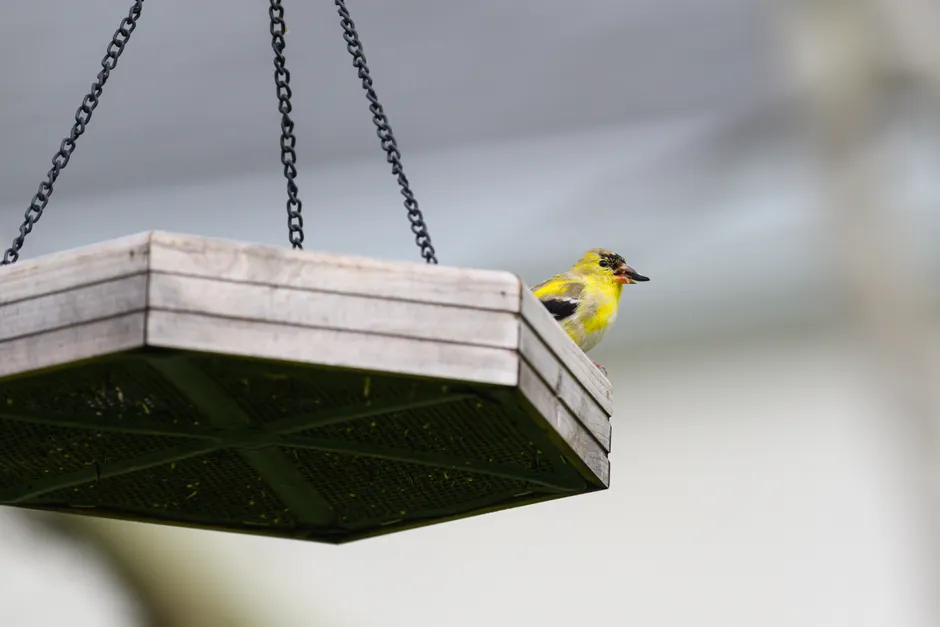
Présenté au CES 2026le BirdBuddy 2 Mini reprend la caméra 2K et les fonctions d’identification par IA du modèle principal dans un format plus compact. Il pourra reconnaître les oiseaux à l’image, mais aussi à leur chant, pour 129 dollars et une livraison annoncée à la fin de 2026.
BirdBuddy avait dévoilé le BirdBuddy 2 à la mi-2025, sans encore l’avoir expédié au moment de présenter son petit frère. Le Mini vise les balcons, les petites terrasses et les endroits où une grosse réserve de graines devient vite encombrante. On installe la mangeoire, la caméra observe les visiteurs et l’application rassemble les séquences. Le jardin connecté commence donc à ressembler à un fil d’actualité, avec des plumes à la place des notifications.
Le petit oiseau va sortir, mais en 2K
Le BirdBuddy 2 Mini intègre une caméra capable d’enregistrer en 2K. La détection d’un oiseau déclenche la capture, avec une prise en charge du ralenti pour examiner un envol ou un passage rapide sur le perchoir. Les vidéos peuvent être exportées au format horizontal ou vertical, sans recadrage de fortune avant un partage.
L’application ajoute une identification assistée par IA et des informations sur l’espèce détectée. Les précédentes mangeoires BirdBuddy analysaient déjà les images, mais le Mini peut aussi exploiter le chant des oiseaux. La caméra ne cherche plus seulement le bon angle : elle tente aussi d’identifier ce qui se passe hors champ.
Cette fonction audio reste une aide à l’identification, pas un inventaire naturaliste certifié. Le vent, plusieurs oiseaux présents en même temps ou des espèces proches peuvent compliquer l’analyse. L’IA écoute, oui. Elle ne devient pas ornithologue diplômée en claquant des doigts.
Mini par la taille, pas par l’appétit

La différence la plus visible avec le BirdBuddy 2 concerne le gabarit. Le Mini prend moins de place, mais sa capacité de stockage des graines diminue aussi. Pour un balcon, le compromis est cohérent. En revanche, les oiseaux risquent de transformer le perchoir en cantine avec remplissage plus fréquent à la clé.
Un panneau solaire et un prolongateur de perchoir figurent parmi les accessoires prévus. Le BirdBuddy 2 intègre ses panneaux solaires dans sa conception, tandis que le Mini demande de choisir l’extension adaptée à l’installation. Les deux appareils partagent la même caméra et les mêmes fonctions d’IA, mais pas la même approche du volume.
L’IA prête l’oreille aux plumes
La reconnaissance des chants constitue le changement le plus net de cette génération. Une mangeoire équipée d’une caméra dépend naturellement de la présence de l’oiseau dans son champ de vision. L’analyse audio peut compléter l’image lorsqu’un visiteur chante à proximité sans se poser au bon endroit. La vidéo reste alors utile pour vérifier ce que l’application a proposé.
Le résultat dépendra de la base de reconnaissance, des conditions sonores et des espèces couvertes. Aucun score de précision indépendant ne permet encore de juger cette fonction avant la sortie du produit. La promesse est plus modeste qu’un outil de suivi scientifique : rendre l’identification accessible sans demander de différencier soi-même chaque silhouette et chaque chant.
Le revers est prévisible. Si chaque passage déclenche une vidéo et une notification, une mangeoire connectée peut vite devenir une petite usine à alertes. Le réglage de la fréquence des notifications pèsera donc presque autant que la qualité de l’IA. Sinon, ça va gazouiller sévère dans l’application.
129 dollars, puis migration vers 2026

Le prix annoncé du BirdBuddy 2 Mini est de 129 dollars. Le BirdBuddy 2 doit coûter 189 dollars, soit 60 dollars de plus. Cet écart correspond surtout à une réserve de graines plus importante et au solaire intégré du modèle principal, pas à une caméra supérieure.
Les précommandes du Mini doivent commencer à la mi-2026 et les expéditions à la fin de la même année. Le produit a donc été montré au CES 2026 plusieurs mois avant son arrivée prévue chez les premiers acheteurs. Le prix picore, le délai, lui, a déjà migré.
BirdBuddy a aussi présenté les caméras Wonder Blocks et Petalannoncées une première fois au CES 2025. Ces produits ont réuni près de 2,5 millions de dollars sur Kickstarter et doivent commencer à être expédiés plus tard en 2026. La marque construit ainsi une gamme d’observation de la faune autour de plusieurs appareils, au lieu de miser sur une seule mangeoire.
Du jardin connecté au vrai travail de terrain
Le BirdBuddy 2 Mini reste un produit grand public, pas un système de suivi scientifique. Une étude publiée en juillet 2024 dans Ecology and Evolutionmenée sur 46 sites de Nouvelle-Galles du Sud entre 2018 et 2022, a comparé plusieurs méthodes de détection des koalas. La détectabilité moyenne atteignait 0,32 avec 24 heures d’enregistrement acoustique, contre 0,019 avec 24 heures de piège photo utilisant six caméras.
Ces chiffres ne permettent pas de juger directement le Mini, car les espèces, les appareils et les objectifs diffèrent. Ils rappellent toutefois qu’une étiquette d’espèce et une belle image ne garantissent pas que tous les animaux présents ont été détectés. Pour observer les oiseaux de son balcon, le concept tient la route. Pour mesurer une population, il faut un protocole autrement plus carré.
Le BirdBuddy 2 Mini mise donc sur un format compact, une vidéo 2K et une identification qui passe de l’image au son. Il faudra vérifier la précision audio et la régularité des expéditions lorsque les premières unités quitteront réellement l’usine. Le plus gros oiseau à apprivoiser sera peut-être le calendrier.
Sources et références scientifiques
- Andrew O'Hara. BirdBuddy 2 mini smart feeder films wildlife with a 2K camera. 2026.
- Attenborough’s echidna rediscovered by combining Indigenous knowledge with camera-trapping – PMC. npj biodiversity. DOI: 10.1038/s44185-025-00086-6 · PMID: 40355643.
- 1.Long, B. & Rodríguez, J. P. Lost but not forgotten: a new nomenclature to support a call to rediscover and conserve lost species. Oryx56, 481-482 (2022). [Google Scholar].
- 2.Lees, A. C. & Pimm, S. L. Species, extinct before we know them?. Curr. Biol.25, R177-R180 (2015). [DOI] [PubMed] [Google Scholar].
- 3.Nguyen, A. et al. Camera-trap evidence that the silver-backed chevrotain Tragulus versicolor remains in the wild in Vietnam. Nat. Ecol. Evol.10.1038/s41559-019-1027-7 (2019). [DOI] [PubMed]. doi:10.1038/s41559-019-1027-7.
- 4.Mulcahy, D. G., Martínez-Gómez, J. E, Aguirre-León, G., Cervantes-Pasqualli, J. A. & Zug, G. R. Rediscovery of an endemic vertebrate from the remote Islas Revillagigedo in the Eastern Pacific Ocean: The Clarión Nightsnake lost and found. PLoS ONE9, e97682 (2014). [DOI] [PMC free article] [PubMed] [Google Scholar].
- ehler, B. M. & Prawiradilaga, D. M. New taxa and new records of birds from the north coastal ranges of New Guinea. 130, 277-285 (2010)..
- 6.Diamond, J. M. New distributional records and taxa from the outlying mountain ranges of New Guinea. Emu – Austral Ornithol.85, 65-91 (1985). [Google Scholar].
- 7.Flannery, T. F. & Groves, C. P. A revision of the genus Zaglossus (Monotremata, Tachyglossidae), with description of new species and subspecies. Mammalia62, 367-396 (1998). [Google Scholar].
- 8.Zhou, Y. et al. Platypus and echidna genomes reveal mammalian biology and evolution. Nature592, 756-762 (2021). [DOI] [PMC free article] [PubMed] [Google Scholar].
- 9.Flannery, T. F. et al. A review of monotreme (Monotremata) evolution. Alcheringa: Australas. J. Palaeontol.46, 3-20 (2022). [Google Scholar].
- 10.Flannery, T. F. et al. A diverse assemblage of monotremes (Monotremata) from the Cenomanian Lightning Ridge fauna of New South Wales, Australia. Alcheringa: Australas. J. Palaeontol.48, 319-337 (2024). [Google Scholar].
- 11.Leary, T. et al. Zaglossus Attenboroughi. The IUCN Red List of Threatened Species 2016: E.T136322A2196435. 10.2305/.2016-2.RLTS.T136322A21964353.e (2016).. doi:10.2305/IUCN.UK.2016-2.RLTS.T136322A21964353.e.
- 12.Isaac, N. J. B, Turvey, S. T., Collen, B., Waterman, C. & Baillie, J. E. M. Mammals on the EDGE: conservation priorities based on threat and phylogeny. PLoS ONE2, e296 (2007). [DOI] [PMC free article] [PubMed] [Google Scholar].
- Epidemiological Dynamics of a Visually Apparent Disease: Camera Trapping and Machine‐Learning Applied to Rumpwear in the Common Brushtail Possum – PMC. Integrative zoology. DOI: 10.1111/1749-4877.12995 · PMID: 40437839.
- Altizer, S., Dobson A., Hosseini P., Hudson P., Pascual M., and Rohani P.. 2006. “Seasonality and the Dynamics of Infectious Diseases.” Ecology Letters 9: 467-484. [DOI] [PubMed] [Google Scholar].
- Altizer, S., Nunn C. L., Thrall P. H., et al. 2003. “Social Organization and Parasite Risk in Mammals: Integrating Theory and Empirical Studies.” Annual Review of Ecology, Evolution, and Systematics 34, no. 1: 517-547. [Google Scholar].
- Arneberg, P., Skorping A., Grenfell B., and Read A. F.. 1998. “Host Densities as Determinants of Abundance in Parasite Communities.” Proceedings of the Royal Society of London B: Biological Sciences 265, no. 1403: 1283-1289. [Google Scholar].
- Bakthavatchalu, V., Muthupalani S., Marini R. P., and Fox J. G.. 2016. “Endocrinopathy and Aging in Ferrets.” Veterinary Pathology 53, no. 2: 349-365. [DOI] [PMC free article] [PubMed] [Google Scholar].
- Barnett, J., How R., and Humphreys W.. 1979. “Blood Parameters in Natural Populations of Trichosurus Species (Marsupialia: Phalangeridae) II. Influence of Habitat and Population Strategies of T. caninus and T. vulpecula.” Australian Journal of Zoology 27, no. 6: 927-938. [Google Scholar].
- Beery, S., Morris D., and Yang S.. 2019. Efficient Pipeline for Camera Trap Image Review. arXiv: 1907.06772. 10.48550/arXiv.1907.06772. [DOI]. doi:10.48550/arXiv.1907.06772.
- Bethge, J., Fietz J., Razafimampiandra J. C., Ruthsatz K., and Dausmann K. H.. 2022. “Season and Reproductive Activity Influence Cortisol Levels in the Malagasy Primate Lepilemur edwardsi.” Journal of Experimental Zoology Part A: Ecological and Integrative Physiology 337: 994-1001. [DOI] [PubMed] [Google Scholar].
- Bethge, J., Razafimampiandra J. C., Wulff A., and Dausmann K. H.. 2023. “Seasonal Changes in the Parasite Prevalence of a Small Malagasy Lemur Species (Lepilemur edwardsi).” Integrative Zoology 18, no. 3: 427-439. [DOI] [PubMed] [Google Scholar].
- Broadley, K., Burton A. C., Avgar T., and Boutin S.. 2019. “Density‐Dependent Space Use Affects Interpretation of Camera Trap Detection Rates.” Ecology and Evolution 9, no. 24: 14031-14041. [DOI] [PMC free article] [PubMed] [Google Scholar].
- Bryan, H. M., Darimont C. T., Hill J. E., et al. 2012. “Seasonal and Biogeographical Patterns of Gastrointestinal Parasites in Large Carnivores: Wolves in a Coastal Archipelago.” Parasitology 139, no. 6: 781-790. [DOI] [PubMed] [Google Scholar].
- Caldwell, J. M., Heron S. F., Eakin C. M., and Donahue M. J.. 2016. “Satellite SST‐Based Coral Disease Outbreak Predictions for the Hawaiian Archipelago.” Remote Sensing 8, no. 2: 93. [DOI] [PMC free article] [PubMed] [Google Scholar].
- Caley, P., Coleman J. D., and Hickling G. J.. 2001. “Habitat‐Related Prevalence of Macroscopic Mycobacterium bovis Infection in Brushtail Possums (Trichosurus vulpecula), Hohonu Range, Westland, New Zealand.” New Zealand Veterinary Journal 49, no. 3: 82-87. [DOI] [PubMed] [Google Scholar].
- Range‐Wide Camera Trapping for the Australian Cassowary Reveals Habitat Associations With Rainfall and Forest Quality – PMC. Ecology and evolution. DOI: 10.1002/ece3.71464 · PMID: 40469466.
- Amir, Z., Moore J. H., Negret P. J., and Luskin M. S.. 2022. “Megafauna Extinctions Produce Idiosyncratic Anthropocene Assemblages.” Science Advances 8: eabq2307. [DOI] [PMC free article] [PubMed] [Google Scholar].
- Amir, Z., Sovie A., and Luskin M. S.. 2022. “Inferring Predator-Prey Interactions From Camera Traps: A Bayesian Co‐Abundance Modeling Approach.” Ecology and Evolution 12: e9627. [DOI] [PMC free article] [PubMed] [Google Scholar].
- Andy, L. 2021. “‘Tourist Fiction’: Cassowaries in Mission Beach.” Queensland Review 28: 183-186. [Google Scholar].
- Bertram, B. C. R. 2014. The Ostrich Communal Nesting System, 1. Princeton University Press. [Google Scholar].
- Betts, M. G., Wolf C., Pfeifer M., et al. 2019. “Extinction Filters Mediate the Global Effects of Habitat Fragmentation on Animals.” Science 366: 1236-1239. [DOI] [PubMed] [Google Scholar].
- BirdLife International. 2017. “Casuarius casuarius.” The IUCN. Red List of Threatened Species eT22678108A131902050..
- Bradford, M. G., Dennis A. J., and Westcott D. A.. 2008. “Diet and Dietary Preferences of the Southern Cassowary ( Casuarius casuarius ) in North Queensland, Australia.” Biotropica 40: 338-343. [Google Scholar].
- Bradford, M. G., and Westcott D. A.. 2010. “Consequences of Southern Cassowary ( Casuarius casuarius, L.) Gut Passage and Deposition Pattern on the Germination of Rainforest Seeds.” Austral Ecology 35: 325-333. [Google Scholar].
- Brodie, J. F., Helmy O. E., Mohd‐Azlan J., et al. 2018. “Models for Assessing Local‐Scale Co‐Abundance of Animal Species While Accounting for Differential Detectability and Varied Responses to the Environment.” Biotropica 50: 5-15. [Google Scholar].
- Bruce, T., Amir Z., Allen B., et al. 2025. “Large‐Scale and Long‐Term Wildlife Research and Monitoring Using Camera Traps: A Continental Synthesis.” Biological Reviews 100: 530-555. [DOI] [PMC free article] [PubMed] [Google Scholar].
- Butt, N., Seabrook L., Maron M., et al. 2015. “Cascading Effects of Climate Extremes on Vertebrate Fauna Through Changes to Low‐Latitude Tree Flowering and Fruiting Phenology.” Global Change Biology 21: 3267-3277. [DOI] [PubMed] [Google Scholar].
- Campbell, H. A., Dwyer R. G., Fitzgibbons S., et al. 2012. “Prioritising the Protection of Habitat Utilised by Southern Cassowaries Casuarius casuarius Johnsonii.” Endangered Species Research 17: 53-61. [Google Scholar].
- Comparing the cost‐effectiveness of drones, camera trapping and passive acoustic recorders in detecting changes in koala occupancy – PMC. Ecology and evolution. DOI: 10.1002/ece3.11659 · PMID: 38957698.
- Bengsen, A. J., Forsyth, D. M., Ramsey, D. S., Amos, M., Brennan, M., Pople, A. R., Comte, S., & Crittle, T. (2022). Estimating deer density and abundance using spatial mark-resight models with camera trap data. Journal of Mammalogy, 103(3), 711-722. 10.1093/jmammal/gyac016 [DOI] [PMC free article] [PubMed] [Google Scholar]. doi:10.1093/jmammal/gyac016.
- Beranek, C. T., Roff, A., Denholm, B., Howell, L. G., & Witt, R. R. (2020). Trialling a real‐time drone detection and validation protocol for the koala (Phascolarctos cinereus). Australian Mammalogy, 43(2), 260-264. 10.1071/AM20043 [DOI] [Google Scholar]. doi:10.1071/AM20043.
- Brack, I. V., Kindel, A., de Oliveira, L. F. B., & Lahoz‐Monfort, J. J. (2023). Optimally designing drone‐based surveys for wildlife abundance estimation with N‐mixture models. Methods in Ecology and Evolution, 14(3), 898-910. 10.1111/2041-210X.14054 [DOI] [Google Scholar]. doi:10.1111/2041-210X.14054.
- Catling, P. C., Burt, R. J., & Kooyman, R. (1997). A comparison of techniques used in a survey of the ground‐dwelling and arboreal mammals in forests in north‐eastern New South Wales. Wildlife Research, 24(4), 417-432. 10.1071/WR96073 [DOI] [Google Scholar]. doi:10.1071/WR96073.
- Caughlan, L., & Oakley, K. L. (2001). Cost considerations for long‐term ecological monitoring. Ecological Indicators, 1(2), 123-134. 10.1016/S1470-160X(01)00015-2 [DOI] [Google Scholar]. doi:10.1016/S1470-160X(01)00015-2.
- Cristescu, R. H., Foley, E., Markula, A., Jackson, G., Jones, D., & Frere, C. (2015). Accuracy and efficiency of detection dogs: A powerful new tool for koala conservation and management. Scientific Reports, 5(1), 8349. 10.1038/srep08349 [DOI] [PMC free article] [PubMed] [Google Scholar]. doi:10.1038/srep08349.
- di Stephano, J. (2003). How much power is enough? Against the development of an arbitrary convention for statistical power calculations. Functional Ecology, 17, 707-709. 10.1046/j.1365-2435.2003.00782.x [DOI] [Google Scholar]. doi:10.1046/j.1365-2435.2003.00782.x.
- Ellis, W., Bercovitch, F., Fitzgibbon, S., Roe, P., Wimmer, J., Melzer, A., & Wilson, R. (2011). Koala bellows and their association with the spatial dynamics of free‐ranging koalas. Behavioral Ecology, 22(2), 372-377. 10.1093/beheco/arq216 [DOI] [Google Scholar]. doi:10.1093/beheco/arq216.
- Field, S. A., Tyre, A. J., & Possingham, H. P. (2005). Optimising allocation of monitoring effort under economic and observational constraints. The Journal of Wildlife Management, 69(2), 473-482. 10.2193/0022-541X(2005)069[0473:OAOMEU]2.0.CO;2 [DOI] [Google Scholar]. doi:10.2193/0022-541X(2005)069.
- Fiske, I., & Chandler, R. (2011). Unmarked: An R package for fitting hierarchical models of wildlife occurrence and abundance. Journal of Statistical Software, 43, 1-23. 10.18637/jss.v043.i10 [DOI] [Google Scholar]. doi:10.18637/jss.v043.i10.
- Goldingay, R. L., McHugh, D., & Parkyn, J. L. (2022). Multiyear monitoring of threatened iconic arboreal mammals in a mid‐elevation conservation reserve in eastern Australia. Ecology and Evolution, 12(5), e8935. 10.1002/ece3.8935 [DOI] [PMC free article] [PubMed] [Google Scholar]. doi:10.1002/ece3.8935.
- Guillera‐Arroita, G., & Lahoz‐Monfort, J. J. (2012). Designing studies to detect differences in species occupancy: Power analysis under imperfect detection. Methods in Ecology and Evolution, 3(5), 860-869. 10.1111/j.2041-210X.2012.00225.x [DOI] [Google Scholar]. doi:10.1111/j.2041-210X.2012.00225.x.
- AppleInsider. BirdBuddy 2 mini smart feeder films wildlife with a 2K camera – NewsBreak. 2026.
- Adam Juniper. Birdbuddy reveals a new mini flagship bird feeder camera that can identify a bird just by listening to it!. 2026.
- BirdBuddy 2 Mini Launch at CES 2026: AI‑Powered Smart Bird Feeder – UBOS.