Le projet Apple Car n’a jamais fait l’objet d’une présentation commerciale détaillée par Apple. Les brevets publics donnent toutefois un aperçu de deux pistes précises : une bande lumineuse qui enveloppe la carrosserie et des fenêtres capables de masquer l’habitacle.
Un brevet protège une solution technique, pas un produit vendu. Les documents déposés au fil d’un projet long peuvent se chevaucher ou se contredire. Il faut donc les lire comme des traces de recherche, pas comme la fiche technique d’une voiture finale.
Une keynote sur quatre roues, mais sans fiche technique
Le dossier ne raconte pas une voiture achevée. Il montre plutôt une série d’expérimentations autour de l’extérieur du véhicule, avec une même obsession : faire de surfaces habituellement passives des interfaces capables de réagir à leur environnement.
Cette approche explique aussi les écarts entre les documents. Une idée peut apparaître dans une première demande, évoluer dans une autre, puis disparaître d’un dépôt ultérieur. On obtient un puzzle technologique, pas le plan d’un modèle que l’on pourrait commander en ligne. Pas de prix, pas de benchmark, pas d’autonomie réelle : ça calme vite les fantasmes.
Le cœur du dossier tient en deux idées : faire parler la carrosserie et rendre les vitres sélectives.
Des feux qui parlent, Apple fait le show
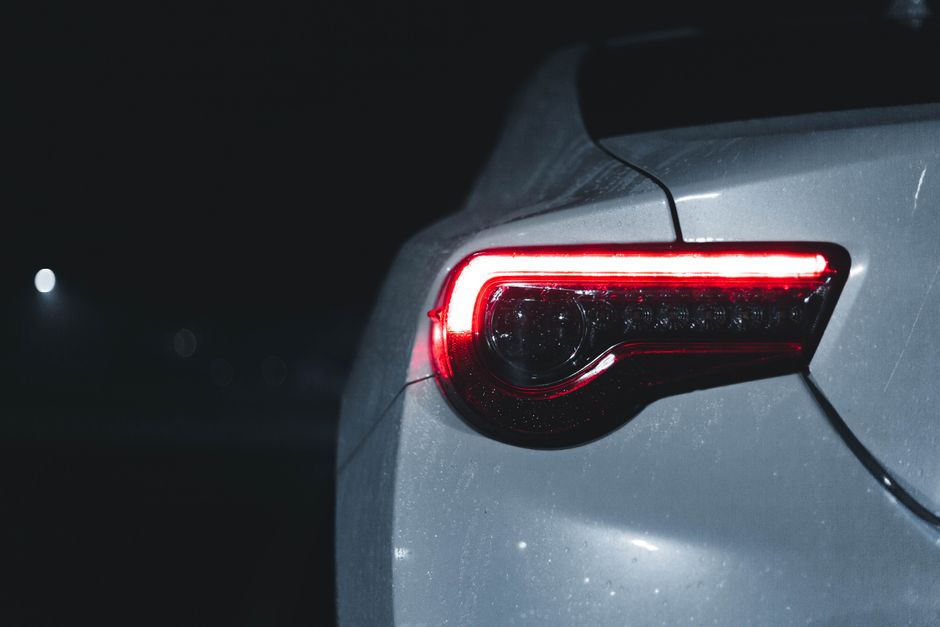
Photo de Wade Lambert sur Unsplash.
Dans un brevet accordé en 2021, intitulé Exterior Lighting and Warning SystemApple propose d’aller plus loin que le clignotant classique. La voiture pourrait intégrer une bande lumineuse continue autour de la carrosserie, avec la possibilité d’afficher des signaux et même des messages à destination des autres usagers.
La différence avec une simple signature lumineuse est nette. Le feu ne se contenterait plus d’indiquer une direction ou un freinage : il deviendrait une surface d’information. Sur le papier, c’est une manière très Apple de traiter un élément banal de la voiture, en lui ajoutant une couche d’interface. En pratique, la lisibilité, la réglementation et la fiabilité devraient suivre. Sinon, on obtient un joli spectacle qui tousse au moment où il faut signaler un danger.
Les vitres passent en mode Knight Rider
Photo de Konrad Bednarek sur Unsplash.
Un autre brevet accordé en 2019 s’intéresse à des fenêtres capables de laisser les occupants regarder dehors tout en limitant la visibilité vers l’intérieur. Le dispositif décrit une couche modulatrice de lumière, éventuellement fondée sur des cristaux liquides, associée à une couche de brume réglable.
Le principe rappelle les vitres polarisantes de certaines voitures de science-fiction : l’habitacle peut devenir difficile à observer depuis l’extérieur, tandis que les passagers conservent une vue vers la route. Apple cherchait ainsi à transformer la confidentialité en équipement intégré à la carrosserie, sans ajouter un simple rideau ou un film posé après achat.
La limite est immédiate. Une vitre assombrie ne doit pas gêner la vision des occupants ni le fonctionnement des capteurs. Le brevet décrit une solution possible, pas le résultat d’un essai routier ni une homologation. La nuance évite de transformer une idée de laboratoire en promesse de catalogue.
Le brevet ne passe pas le contrôle technique
Pris ensemble, ces documents dessinent une voiture dont la carrosserie aurait affiché des informations et dont les vitres auraient géré la visibilité. Ils montrent aussi la difficulté du projet : chaque idée implique des contraintes de sécurité, de réglementation, de production et de maintenance.
Le plus solide que l’on puisse en tirer reste donc une direction de recherche. Les feux-écrans et les fenêtres adaptatives appartiennent au registre des possibilités protégées, pas à celui des spécifications confirmées. La keynote pouvait faire son show; le contrôle technique, lui, aurait demandé quelques réponses.
Sources et références scientifiques
William Gallagher. Patents, research, and rumors: Everything the Apple Car was going to be. 2025.
Hydrogel-Based Biomaterials: A Patent Landscape on Innovation Trends and Patterns – PMC. Gels (Basel, Switzerland). DOI: 10.3390/gels11030216 · PMID: 40136921.
1.Advincula R.C., Dizon J.R.C., Caldona E.B., Viers R.A., Siacor F.D.C., Maalihan R.D., Espera A.H. On the progress of 3D-printed hydrogels for tissue engineering. MRS Commun. 2021;11:539-553. doi: 10.1557/s43579-021-00069-1. [DOI] [PMC free article] [PubMed] [Google Scholar]. doi:10.1557/s43579-021-00069-1.
2.Jacob S., Nair A.B., Shah J., Sreeharsha N., Gupta S., Shinu P. Emerging Role of Hydrogels in Drug Delivery Systems, Tissue Engineering and Wound Management. Pharmaceutics. 2021;13:357. doi: 10.3390/pharmaceutics13030357. [DOI] [PMC free article] [PubMed] [Google Scholar]. doi:10.3390/pharmaceutics13030357.
3.Revete A., Aparicio A., Cisterna B.A., Revete J., Luis L., Ibarra E., Segura González E.A., Molino J., Reginensi D. Advancements in the Use of Hydrogels for Regenerative Medicine: Properties and Biomedical Applications. Int. J. Biomater. 2022;2022:3606765. doi: 10.1155/2022/3606765. [DOI] [PMC free article] [PubMed] [Google Scholar]. doi:10.1155/2022/3606765.
4.Damiri F., Fatimi A., Liu Y., Musuc A.M., Fajardo A.R., Gowda B.H.J., Vora L.K., Shavandi A., Okoro O.V. Recent advances in 3D bioprinted polysaccharide hydrogels for biomedical applications: A comprehensive review. Carbohydr. Polym. 2025;348:122845. doi: 10.1016/rbpol.2024.122845. [DOI] [PubMed] [Google Scholar]. doi:10.1016/j.carbpol.2024.122845.
5.Sikdar P., Uddin M.M., Dip T.M., Islam S., Hoque M.S., Dhar A.K., Wu S. Recent advances in the synthesis of smart hydrogels. Mater. Adv. 2021;2:4532-4573. doi: 10.1039/D1MA00193K. [DOI] [Google Scholar]. doi:10.1039/D1MA00193K.
6.Bashir S., Hina M., Iqbal J., Rajpar A.H., Mujtaba M.A., Alghamdi N.A., Wageh S., Ramesh K., Ramesh S. Fundamental Concepts of Hydrogels: Synthesis, Properties, and Their Applications. Polymers. 2020;12:2702. doi: 10.3390/polym12112702. [DOI] [PMC free article] [PubMed] [Google Scholar]. doi:10.3390/polym12112702.
7.Damiri F., Fatimi A., Santos A.C.P., Varma R.S., Berrada M. Smart stimuli-responsive polysaccharide nanohydrogels for drug delivery: A review. J. Mater. Chem. B. 2023;11:10538-10565. doi: 10.1039/d3tb01712e. [DOI] [PubMed] [Google Scholar]. doi:10.1039/d3tb01712e.
8.Liu H., Wang C., Li C., Qin Y., Wang Z., Yang F., Li Z., Wang J. A functional chitosan-based hydrogel as a wound dressing and drug delivery system in the treatment of wound healing. RSC Adv. 2018;8:7533-7549. doi: 10.1039/C7RA13510F. [DOI] [PMC free article] [PubMed] [Google Scholar]. doi:10.1039/C7RA13510F.
9.Hachimi Alaoui C., Réthoré G., Weiss P., Fatimi A. Sustainable Biomass Lignin-Based Hydrogels: A Review on Properties, Formulation, and Biomedical Applications. Int. J. Mol. Sci. 2023;24:13493. doi: 10.3390/ijms241713493. [DOI] [PMC free article] [PubMed] [Google Scholar]. doi:10.3390/ijms241713493.
10.Xia Z., Guo B., Wu D., Yang F., Ding Y. Advances of natural hydrogel-based vascularization strategies for soft tissue repair. Front. Mater. 2024;11:1446035. doi: 10.3389/fmats.2024.1446035. [DOI] [Google Scholar]. doi:10.3389/fmats.2024.1446035.
11.León-Campos M.I., Claudio-Rizo J.A., Cobos-Puc L.E., Cabrera-Munguia D.A. Cell Differentiation on Hydrogels and its Application in Regenerative Medicine. Front. Stem Cell Regen. Med. Res. 2024;11:24-60. doi: 10.2174/9789815238600124110005. [DOI] [Google Scholar]. doi:10.2174/9789815238600124110005.
12.Kaur H., Gogoi B., Sharma I., Das D.K., Azad M.A., Pramanik D.D., Pramanik A. Hydrogels as a Potential Biomaterial for Multimodal Therapeutic Applications. Mol. Pharm. 2024;21:4827-4848. doi: 10.1021/acs.molpharmaceut.4c00595. [DOI] [PMC free article] [PubMed] [Google Scholar]. doi:10.1021/acs.molpharmaceut.4c00595.
nton JG, Brown BB, Rusk HA. Energy expended by patients on bedpans. JAMA. 1950;144(17):1443-17. [DOI] [PubMed] [Google Scholar].
illeteau A, Brillac D, Debat N, et al. Bedpan manipulation: patient comfort and staff constraints, which levers can be used for improvement? PLoS One. 2024;19(7):e0306773. doi: 10.1371/journal.pone.0306773 [DOI] [PMC free article] [PubMed] [Google Scholar]. doi:10.1371/journal.pone.0306773.
3.Garg A, Owen B. Reducing back stress to nursing personnel: an ergonomic intervention in a nursing home. Ergonomics. 1992;35(11):1353-1375. doi: 10.1080/00140139208967398 [DOI] [PubMed] [Google Scholar]. doi:10.1080/00140139208967398.
4.Fader M, Pett Ersson L, Dean G, Brooks R, Cottenden A. The selection of female urinals: the contribution of one continence clinic. Br J Nurs. 1999;8(14):918-925. doi: 10.12968/bjon.1999.8.14.6540 [DOI] [PubMed] [Google Scholar]. doi:10.12968/bjon.1999.8.14.6540.
5.Centers for Disease Control and Prevention. Summary of recommendations: catheter-associated urinary tract infections (CAUTI). Centers for Disease Control and Prevention website. 2024. Available from: Accessed January 12, 2026..
6.National Institute for Health and Care Excellence (NICE). Infection pssrevention and control. Quality standard QS61: quality statement 4: urinary catheters. 2014. Available from: Accessed January 12, 2026..
7.European Commission. Directorate-General for Research and Innovation. Gendered Innovations 2: How Inclusive Analysis Contributes to Research and Innovation. Publications Office of the European Union; 2020. [Google Scholar].
8.Abelson B, Sun D, Que L, et al. Sex differences in lower urinary tract biology and physiology. Biol Sex Differ. 2018;9:45. doi: 10.1186/s13293-018-0204-8 [DOI] [PMC free article] [PubMed] [Google Scholar]. doi:10.1186/s13293-018-0204-8.
eson T, Graham J, Vowell V, et al. Effectiveness and acceptability of a female external urine diversion device as an alternative to indwelling catheter use in acute care. J Wound Ostomy Continence Nurs. 2023;50(1):38-44. doi: 10.1097/WON.0000000000000923 [DOI] [Google Scholar]. doi:10.1097/WON.0000000000000923.
10.McRae AD, Thomas B, Parsons D, et al. Evaluation of external female urinary catheters: a retrospective analysis of efficacy and clinical outcomes. Continence. 2023;7:100750. doi: 10.1016/j.cont.2023.100750 [DOI] [Google Scholar]. doi:10.1016/j.cont.2023.100750.
11.Pryor N, Wang J, Young J, et al. Clinical outcomes of female external urine wicking devices as alternatives to indwelling catheters: a systematic review and meta-analysis. Infect Control Hosp Epidemiol. 2024;45(9):1121-1129. doi: 10.1017/ice.2024.73 [DOI] [PMC free article] [PubMed] [Google Scholar]. doi:10.1017/ice.2024.73.
anisation for Economic Co-operation and Development (OECD). Intellectual property and emerging technologies: IP-based approaches to technology transfers and licensing. OECD; 2020. [Google Scholar].
Patent Landscape of Fiber-Based Fabrication Technologies for Functional Biomaterials: Electrospinning, Forcespinning® and Melt Electrowriting in Tissue Engineering and Drug Delivery (2020 to 2024) – PMC. Journal of functional biomaterials. DOI: 10.3390/jfb17010008 · PMID: 41590776.
1.Wang C., Wang W., Qi H., Dai Y., Jiang S., Ding B., Wang X., Li C., Zeng J., Wu T., et al. Electrospinning and Electrospun Nanofibers: From Academic Research to Industrial Production. Prog. Mater. Sci. 2025;154:101494. doi: 10.1016/j.pmatsci.2025.101494. [DOI] [Google Scholar]. doi:10.1016/j.pmatsci.2025.101494.
2.Zhang Y., Wang P., Shi Q., Ning X., Zheng J., Long Y.Z. Research Progress and Prospect of Centrifugal Electrospinning and Its Application. J. Alloys Compd. 2024;990:174433. doi: 10.1016/j.jallcom.2024.174433. [DOI] [Google Scholar]. doi:10.1016/j.jallcom.2024.174433.
3.Ahmed J., Gultekinoglu M., Edirisinghe M. Recent Developments in the Use of Centrifugal Spinning and Pressurized Gyration for Biomedical Applications. Wiley Interdiscip. Rev. Nanomed. Nanobiotechnol. 2024;16:e1916. doi: 10.1002/wnan.1916. [DOI] [PubMed] [Google Scholar]. doi:10.1002/wnan.1916.
4.Celebioglu A., Uyar T. Fast Dissolving Oral Drug Delivery System Based on Electrospun Nanofibrous Webs of Cyclodextrin/Ibuprofen Inclusion Complex Nanofibers. Mol. Pharm. 2019;16:4387-4398. doi: 10.1021/acs.molpharmaceut.9b00798. [DOI] [PubMed] [Google Scholar]. doi:10.1021/acs.molpharmaceut.9b00798.
5.Xu T., Gu J., Meng J., Du L., Kumar A., Xu H. Melt Electrowriting Reinforced Composite Membrane for Controlled Drug Release. J. Mech. Behav. Biomed. Mater. 2022;132:105277. doi: 10.1016/j.jmbbm.2022.105277. [DOI] [PubMed] [Google Scholar]. doi:10.1016/j.jmbbm.2022.105277.
6.Luxenhofer R., Keßler L., Mirzaei Z., Kade J.C. Highly Porous and Drug-Loaded Amorphous Solid Dispersion Microfiber Scaffolds of Indomethacin Prepared by Melt Electrowriting. ACS Appl. Polym. Mater. 2023;5:913-922. doi: 10.1021/acsapm.2c01845. [DOI] [Google Scholar]. doi:10.1021/acsapm.2c01845.
8.Zhang J., Yu M., Tao S. Advanced Electrospinning Nanomaterials: From Spinning Fabrication Techniques to Electrochemical Applications. Nano Res. 2024;17:7077-7116. doi: 10.1007/s12274-024-6753-8. [DOI] [Google Scholar]. doi:10.1007/s12274-024-6753-8.
9.Ji D., Lin Y., Guo X., Ramasubramanian B., Wang R., Radacsi N., Jose R., Qin X., Ramakrishna S. Electrospinning of Nanofibres. Nat. Rev. Methods Primers. 2024;4:1. doi: 10.1038/s43586-023-00278-z. [DOI] [Google Scholar]. doi:10.1038/s43586-023-00278-z.
10.Serik A., Idrissov N., Baratov A., Dikov A., Kislitsin S., Daulbayev C., Kuspanov Z., Serik A., Idrissov N., Baratov A., et al. Recent Progress in Photocatalytic Applications of Electrospun Nanofibers: A Review. Molecules. 2024;29:4824. doi: 10.3390/molecules29204824. [DOI] [PMC free article] [PubMed] [Google Scholar]. doi:10.3390/molecules29204824.
11.Zheng Q., Xi Y., Weng Y. Functional Electrospun Nanofibers: Fabrication, Properties, and Applications in Wound-Healing Process. RSC Adv. 2024;14:3359-3378. doi: 10.1039/D3RA07075A. [DOI] [PMC free article] [PubMed] [Google Scholar]. doi:10.1039/D3RA07075A.
12.Eynde V., Sezer F., Deniz S., Franco R.F., Jimenez P.C. Pharmacological Applications of Electrospun Nanofibers Loaded with Bioactive Natural Compounds and Extracts: A Systematic Review. Drugs Drug Candidates. 2025;4:8. doi: 10.3390/ddc4010008. [DOI] [Google Scholar]. doi:10.3390/ddc4010008.
Kalinin DV.. Recent advances in factor XII(a) inhibitors: an updated patent landscape (2020-present).. Expert opinion on therapeutic patents. 2026. DOI: 10.1080/13543776.2026.2627911 · PMID: 41640375. (résumé scientifique structuré; texte intégral non fourni)
Patents, research, and rumors: Everything the Apple Car was going to be, AppleInsider Forums.
Bonjour ! Je suis Yves, un passionné de technologie et du web, âgé de 35 ans. J'adore explorer les innovations numérique et partager mes connaissances avec autrui. Mon objectif est d'aider chacun à naviguer dans l'univers digital avec aisance. Bienvenue sur mon site !
Nous utilisons des cookies pour vous garantir la meilleure expérience sur notre site web. Si vous continuez à utiliser ce site, nous supposerons que vous en êtes satisfait.